
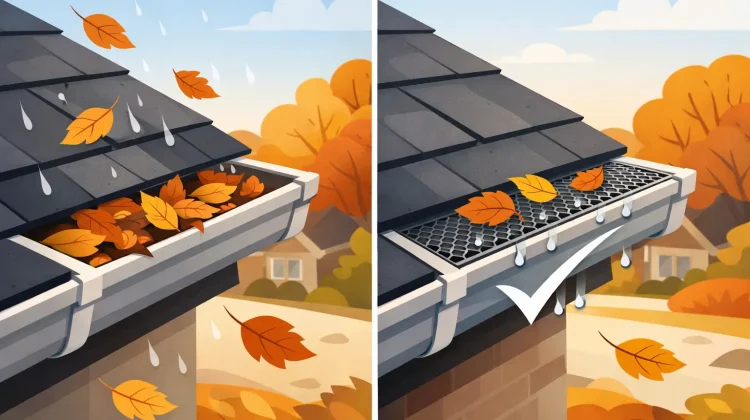
A gutter can look clear on a sunny day and still fail during the next hard rain. In New Jersey and Staten Island, falling leaves, pine needles, roof grit, and windblown debris can turn a working drainage system into an overflow problem quickly. The best gutter guards for leaves are not simply the ones with the strongest advertising claims. They are the guards that fit your roof, gutter size, surrounding trees, and the way water moves off your home or building.
A good gutter guard should reduce routine cleaning, keep water flowing to the downspouts, and protect the gutter system from heavy debris buildup. It should also be installed without creating new problems at the roof edge, fascia, or gutter pitch. That is why material and installation matter just as much as the guard style itself.
What the Best Gutter Guards for Leaves Have in Common
The right guard does not make a gutter completely maintenance-free. Leaves can still collect on top of a guard, especially below large deciduous trees or in roof valleys. The goal is to keep debris from entering the gutter while allowing rainwater to pass through reliably.
For most properties, the strongest options share a few traits: durable materials that will not sag or crack, a secure fit to the gutter and fascia, adequate water intake during heavy rain, and openings small enough to block the debris common around the property. A guard that works well under maple trees may not perform the same way under pine trees, where small needles can work into larger openings.
The condition of the existing gutter system also matters. Guards cannot correct undersized gutters, loose fasteners, poor slope, clogged downspouts, or water that overshoots the gutter because of a roof or flashing issue. Before adding guards, it is wise to make sure the drainage system is sound.
Micro-Mesh Gutter Guards: Often the Best All-Around Choice
Micro-mesh guards are a popular choice for homeowners dealing with a mix of leaves, seeds, shingle grit, and pine needles. They use a fine metal screen, usually stainless steel, supported by a rigid frame. Water enters through the mesh while small debris remains on top and is carried away by wind or eventually dries and blows off.
For many homes, micro-mesh provides the best balance of filtration and water flow. The fine openings are particularly useful in wooded areas where pine needles, helicopter seeds, and roof granules are common. Unlike basic screens with larger holes, quality micro-mesh is less likely to let fine debris settle inside the gutter.
There are trade-offs. Not all micro-mesh products are built the same, and a low-quality version can warp, pull loose, or allow debris to accumulate along the front edge. Installation angle also affects performance. If the guard sits too flat or is not positioned correctly beneath the roofline, wet leaves may build up instead of shedding. A properly fitted system is far more important than a one-size-fits-all product installed quickly.
When Micro-Mesh Makes the Most Sense
Micro-mesh is usually a strong fit for homes with mature trees close to the roof, properties that receive heavy leaf fall, and roofs that produce noticeable shingle grit. It can also be a practical choice for property owners who want to reduce the frequency of gutter cleaning without covering the gutter with a solid surface.
It still needs periodic visual checks. After major storms or peak fall leaf season, look for buildup in valleys, at corners, and above downspouts. Clearing the roof surface and guard top before debris becomes compacted helps the whole system perform as intended.
Solid-Surface Guards: Good Water Shedding, More Roof-Specific
Solid-surface gutter guards use a curved or angled cover that directs water into a narrow opening along the edge. They are designed to use water adhesion to guide rain into the gutter while leaves and larger debris slide over the front.
These guards can work well on roofs with the right pitch and consistent water flow. Their smooth surface may shed large leaves effectively, which is appealing for properties with broadleaf trees such as oaks, maples, and sycamores. They can also create a clean, finished appearance along the roofline.
However, solid covers need careful matching to the roof and gutter system. In a very heavy downpour, water may move too quickly to follow the cover into the slot if the profile or installation is not right. Fine debris can also collect at the intake opening. For that reason, this style is not automatically the best solution for every roof, even when it performs well on a neighboring home.
Perforated Aluminum Screens: A Practical Mid-Range Option
Perforated aluminum guards are stronger than lightweight plastic screens and can be an effective choice where the main concern is large leaves. They fit over or into the gutter and use punched openings to let water through while blocking larger debris.
This option can make sense for a property with moderate tree coverage and mostly large leaves. Aluminum resists rust, and a well-secured screen can hold up well through changing weather. The larger holes, however, may allow pine needles, seed pods, roof grit, and small debris into the gutter. Those materials can eventually form a blockage near the downspouts.
For a homeowner looking for basic leaf protection at a lower upfront cost, perforated aluminum may be appropriate. For heavily wooded properties or homes surrounded by pine trees, a finer mesh usually offers better long-term protection.
Brush and Foam Inserts Usually Create More Cleanup Work
Brush-style and foam gutter inserts may appear easy to install, but they often hold onto the very debris they are meant to control. Leaves can become tangled in brushes, while foam inserts may trap grit and organic matter. Once that material stays wet, it can encourage buildup and make cleaning more difficult.
These products may be used as a temporary solution in limited situations, but they are generally not the first choice for a long-lasting gutter protection system. Property owners should be cautious of any guard that works by filling the gutter channel rather than keeping the channel open for water flow.
How to Choose the Right Guard for Your Property
The best decision starts with the property itself. Look at the types of trees around the building, not just how many there are. Large dry leaves behave differently than wet oak leaves, pine needles, seed pods, or small pieces of bark. Consider where debris collects on the roof and whether valleys dump concentrated water into one section of gutter.
Roof pitch and roof material also affect performance. A steep roof can send water quickly into the gutter during a storm, while a shallow roof may allow debris to sit longer near the edge. Asphalt shingles produce granules over time, and those granules can pass through some guard openings. Metal, slate, and tile roofs each require installation methods that protect the roof system and avoid unnecessary penetration or disturbance.
Gutter capacity deserves equal attention. If a home has undersized gutters or too few downspouts, installing guards alone will not stop overflow. Larger gutters and properly placed downspouts may be necessary where roof sections drain a lot of water into one area. Commercial properties and mixed-use buildings often need an even closer review because their rooflines, drainage loads, and maintenance demands can be more complex.
Installation Quality Protects More Than the Gutter
Gutter guards should never be treated as an accessory that can be added without inspecting the system below. Before installation, the gutters should be cleaned, checked for correct pitch, secured to the fascia, and tested for drainage. Downspouts should be clear, and any leaking seams, damaged hangers, or sections pulling away from the building should be addressed first.
A professional installation should preserve the roof edge and avoid creating places where water can back up. Guards need to sit securely enough to handle wind, snow, and seasonal expansion while still allowing access for future service. The installation should also account for the gutter’s profile, the fascia condition, and the roof’s drainage pattern.
Cavallari Gutters approaches guard installation as part of the complete water-management system, not as a quick cover-over. That matters because dependable drainage protects foundations, siding, landscaping, walkways, and the structural areas behind the roofline.
Gutter Guards Still Need Occasional Attention
Even a high-quality guard benefits from seasonal inspection. Check for leaves caught in roof valleys, debris resting on the guard surface, and water staining beneath the gutters after a storm. If water is overflowing, the issue could be debris, but it may also be a blocked downspout, improper slope, or a section of gutter that needs repair.
Most properties with guards require far less cleaning than unprotected gutters, but no system should be ignored for years. A brief inspection in late fall and again after winter can catch small problems before they lead to rotted fascia, basement moisture, or damaged landscaping.
The right gutter guard is one that fits the property and is installed on a properly functioning drainage system. When leaves start falling, that preparation gives water one clear path to follow: safely away from the building.



Leave a Reply