
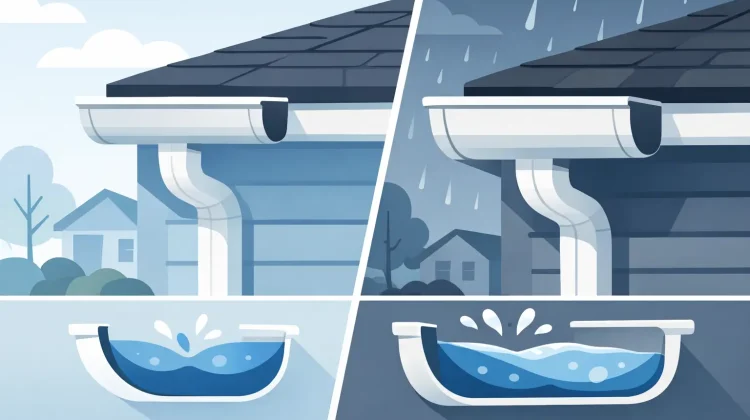
A gutter system can look fine from the ground and still be undersized for the job. That is usually when property owners start asking about 5 inch vs 6 inch gutters – not because they want a bigger profile, but because they are tired of overflow, washout near the foundation, and water ending up where it should not.
Choosing the right size is less about appearance and more about drainage capacity. A one-inch difference may not sound like much, but it can change how much water your gutter system can handle during a hard rain. For homes and commercial properties in New Jersey and Staten Island, where storms can hit fast and rooflines vary a lot from one building to the next, that sizing decision matters.
5 inch vs 6 inch gutters: the real difference
The basic difference is capacity. A 6-inch gutter can carry more water than a 5-inch gutter, which makes it better suited for larger roofs, steeper roof pitches, and areas where heavy rain regularly tests the system.
That does not automatically mean 6-inch gutters are the better choice for every property. A properly designed 5-inch system can perform very well on many homes, especially when the roof area is moderate and the gutter layout includes enough downspouts in the right locations.
What often gets missed is that gutter performance is not based on size alone. The number of downspouts, the slope of the gutters, the roof shape, and how water moves through valleys and corners all affect whether a system works the way it should. Two homes with the same square footage can need very different gutter designs.
When 5-inch gutters make sense
For many standard residential homes, 5-inch gutters are still a practical and effective option. If the roofline is fairly simple, the drainage load is moderate, and the existing system has not shown signs of frequent overflow, a 5-inch gutter may be all you need.
This size is common for traditional single-family homes because it balances performance, appearance, and cost. On homes with average roof sections and standard rainfall runoff, 5-inch gutters often provide enough capacity without overbuilding the system.
They also tend to look proportionate on smaller homes. Some homeowners prefer that because they want the gutter line to blend into the fascia rather than stand out. If the system is pitched correctly and paired with properly sized downspouts, 5-inch gutters can protect siding, landscaping, and foundation areas very well.
That said, 5-inch gutters leave less room for error. If a roof has multiple valleys feeding into one section, or if debris tends to collect quickly, the system can reach its limits faster during heavy storms.
When 6-inch gutters are the better fit
A 6-inch gutter is often the stronger choice when a property needs more drainage capacity and a little more forgiveness during severe weather. That includes larger homes, long roof runs, steep roof slopes, and roof designs that concentrate water into valleys.
This size is also common on commercial buildings and larger residential properties where water volume can overwhelm a standard system. If you have already seen overflow during downpours, staining on siding, soil erosion below the gutter line, or water pooling near the foundation, upsizing may be worth considering.
Another reason contractors recommend 6-inch gutters is future performance. A property may function with 5-inch gutters most of the time, but only until the next intense storm or a partial clog. The extra capacity of a 6-inch system gives more margin when conditions are less than ideal.
For many homeowners, that added margin is the real value. You are not just sizing for a calm rain. You are sizing for the storm that exposes every weakness in the drainage system.
Roof design matters more than many people think
If you are comparing 5 inch vs 6 inch gutters, the roof itself should drive the decision. A large, simple roof can sometimes drain better than a smaller roof with several valleys, dormers, and steep sections feeding water into a few concentrated areas.
Valleys are a major factor because they move water quickly and in volume. Even a home that seems average in size can need 6-inch gutters if several roof sections direct runoff into one stretch of gutter. In those cases, the issue is not total roof square footage alone. It is how fast and how heavily the water arrives.
Pitch matters too. Steeper roofs shed water more aggressively. That creates a heavier rush into the gutter system during storms, which can push a 5-inch system past its capacity if the layout is not carefully designed.
This is why a quick glance from the driveway is not enough to size gutters properly. A reliable recommendation comes from looking at the roof plan, drainage paths, and trouble spots together.
Downspouts can change the answer
A lot of overflow problems get blamed on gutter size when the real issue is downspout design. You can install larger gutters, but if the downspouts are undersized, poorly placed, or too few in number, water still will not move out fast enough.
In some cases, a 5-inch gutter with improved downspout placement can perform better than an older 6-inch system that was laid out poorly. In other cases, the right fix is both a larger gutter and larger downspouts.
That is why the best gutter recommendations are based on the complete system rather than one measurement. Gutters collect the water, but downspouts are what clear it.
Appearance, cost, and long-term value
Most property owners are weighing more than performance alone. Cost and appearance matter too.
A 5-inch system is generally less expensive than a 6-inch system because it uses less material and may be standard for the home. If the property does not need extra capacity, staying with 5-inch gutters can be the sensible choice.
A 6-inch system usually costs more, but the price difference may be small compared to the cost of repeated overflow issues, fascia damage, foundation concerns, or landscape washout. If a building is already near the limit of what 5-inch gutters can handle, going larger can be a smart long-term investment.
Visually, 6-inch gutters are slightly more noticeable, but on many homes they still look clean and proportionate when installed properly. On larger homes and commercial properties, they often look more fitting than a smaller gutter profile.
What about gutter guards?
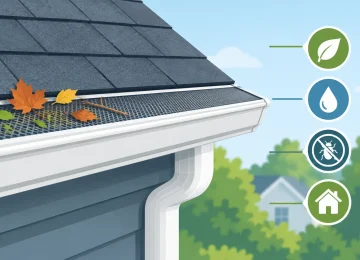
Gutter guards can help reduce debris buildup, but they do not change how much water the gutter can carry. That is an important distinction. If the system is undersized, adding guards will not solve the core capacity problem.
What guards can do is help a correctly sized system maintain performance longer between cleanings. That matters in areas with heavy leaf fall or recurring debris. If you are investing in new gutters, it often makes sense to look at sizing and protection together rather than as separate decisions.
How to know what your property actually needs
The most reliable way to answer the 5 inch vs 6 inch gutters question is to evaluate the specific property, not just the general rule of thumb. Roof area, slope, valley concentration, gutter run length, downspout count, and the history of drainage issues all need to be considered.
If your current gutters overflow at corners, spill during hard rain, pull away from the fascia, or allow water to collect near the base of the building, those are signs the system may be undersized or poorly designed. On the other hand, if the home has a moderate roofline and no recurring drainage issues, there may be no reason to move beyond a properly installed 5-inch system.
For property owners who want a clear answer without guesswork, this is where working with a gutter specialist matters. A contractor who focuses on water management can look at the whole layout and recommend a system based on function, not just what is most common. That is especially useful for mixed-use properties, larger homes, and buildings with problem roof sections.
At Cavallari Gutters, we see this often: the best gutter size is the one that matches the building, the rainfall load, and the way the water actually moves off the roof. If you choose based on that, you are far more likely to end up with a system that protects the property and holds up over time.
A good gutter system should not leave you wondering what happens in the next storm. It should quietly do its job, move water where it belongs, and give you one less exterior problem to worry about.

Leave a Reply