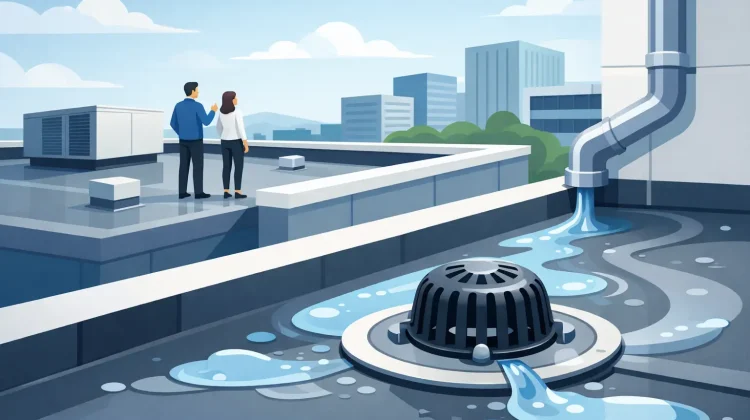
A commercial roof can look fine from the ground while holding water that is slowly working its way toward seams, flashing, walls, and interior spaces. For property owners and managers in New Jersey and Staten Island, heavy rain, wind-driven debris, snowmelt, and freeze-thaw cycles make reliable drainage a year-round building maintenance concern. This commercial roof drainage guide explains what a working system should do, what causes problems, and when a drainage issue deserves prompt professional attention.
Why Commercial Roof Drainage Matters
Commercial drainage is more than getting water off the roof. It is a coordinated path that moves water from the roof surface into drains, scuppers, gutters, downspouts, and finally away from the building foundation, sidewalks, loading areas, and landscaped spaces.
When one part of that path fails, water may pond on the roof, overflow at the edge, stain exterior walls, or spill near entrances. Over time, that can contribute to membrane deterioration, leaks, damaged fascia, foundation moisture, slippery walkways, and premature repair costs. A small clog may be the visible issue, but the underlying cause could be insufficient drainage capacity, poor slope, loose components, or a system that was never sized for the building’s roof area.
Flat and low-slope roofs need particular attention. They are designed with drainage points and subtle slope, not a dramatic pitch that sends water quickly to an edge. Water that remains for more than 48 hours after dry weather returns is often called ponding. Not every shallow puddle means immediate failure, but repeated ponding should be evaluated because standing water adds weight and exposes roof materials to longer periods of moisture.
The Main Parts of a Commercial Roof Drainage System
A building may use one drainage method or a combination of several. The right setup depends on roof size, roof design, local rainfall, building height, exterior layout, and the condition of existing roof and gutter components.
Interior roof drains
Interior drains are common on larger flat or low-slope commercial roofs. Water flows to drain bowls set at low points in the roof, then travels through internal piping. Drain strainers or domes help keep leaves and loose debris out, but they still require cleaning. A blocked interior drain can allow water to collect quickly during a hard storm.
Because these drains are tied into the building’s plumbing drainage system, a roofing professional, gutter specialist, and qualified plumber may each have a role when diagnosing a problem. The roof surface, drain connection, and piping all need to be considered rather than assuming the visible drain is the only issue.
Scuppers and overflow scuppers
Scuppers are openings through a parapet wall that allow roof water to exit into a leader head, downspout, or exterior drainage route. They are simple and effective when correctly sized and kept clear. Their open design also makes it easier to spot overflowing water during a storm.
Overflow scuppers provide a secondary escape route if primary drains become blocked or cannot keep up. They are a critical safety feature on many low-slope roofs because they help prevent water from rising to a level that creates unnecessary structural load. If water regularly discharges from an overflow scupper, treat it as a warning that the primary system needs attention.
Commercial gutters and downspouts
Gutters collect runoff at roof edges and direct it to downspouts. On commercial buildings, they may be installed along sloped rooflines, metal roofing, canopies, storefront awnings, or sections that drain from a higher roof onto a lower one.
Gutter sizing matters. A gutter that is too small, poorly pitched, or served by too few downspouts can overflow even when it is clean. Large roof planes move significant volumes of water in a short time, especially during the fast, heavy storms common in this area. Seam condition, hanger spacing, outlet size, and downspout placement all affect performance.
Downspout discharge and ground drainage
Water has not been properly managed just because it reached the bottom of a downspout. It must discharge away from the building without washing out soil, flooding a walkway, or repeatedly soaking the foundation area. Extensions, underground leaders, splash blocks, and site grading can all be part of the solution.
Underground drainage can keep a property looking cleaner and reduce trip hazards, but it also introduces a concealed maintenance point. If underground lines clog, crack, or drain into saturated soil, water can back up into gutters and downspouts. The best approach depends on the site’s available drainage path and local conditions.
Common Signs Your Drainage System Needs Service
Water problems rarely stay contained to one component. A stain on a ceiling may begin at a roof seam, a blocked drain, a backed-up leader, or water being forced under flashing after an overflow. Regular visual checks can help property managers catch changes before the next major storm.
Watch for these signs:
- Standing water that remains on the roof after 48 hours of dry weather.
- Water spilling over gutter edges or pouring from places other than downspout outlets.
- Sagging, separated, rusted, or visibly loose gutters and downspouts.
- Staining on siding, masonry, soffits, or interior ceilings near roof edges.
- Soil erosion, standing water, or recurring ice near the building foundation and entrances.
- Plants, leaves, roofing gravel, or construction debris collecting around drains and scuppers.
A gutter that overflows in one corner may simply need cleaning, but do not assume that is always the answer. If the problem returns after debris is removed, the system may have a pitch issue, a restricted outlet, an undersized downspout, or drainage capacity that does not match the roof area.
A Practical Commercial Roof Drainage Maintenance Plan
Commercial roofs benefit from scheduled inspection rather than waiting for a leak or overflow. At a minimum, drainage should be checked in the spring and fall, as well as after major storms, high winds, nearby construction work, or periods of heavy leaf drop. Buildings with mature trees, flat roofs, or known drainage concerns may need more frequent service.
During a routine inspection, a qualified professional should clear accessible drains, scuppers, gutters, and downspout outlets; check for loose fasteners, separated seams, corrosion, and damaged strainers; and look for signs that water is bypassing its intended route. The roof surface should also be reviewed for low areas, deteriorated flashing, and debris that may migrate toward drains.
Do not send untrained staff onto a commercial roof to handle drainage issues. Roof access involves fall risks, and walking in the wrong areas can damage roof materials or create liability concerns. A maintenance team can report visible concerns from the ground, such as overflowing gutters or downspouts discharging too close to the structure, while trained professionals handle roof-level work.
When Cleaning Is Enough and When Upgrades Make Sense
Cleaning is often the right first step when leaves, nests, or loose debris are clearly restricting water flow. It is affordable preventive maintenance and can restore normal performance quickly. However, cleaning cannot correct a gutter that pulls away from the fascia, a drain located above a low spot, a cracked downspout, or a discharge point that floods the same area after every storm.
An upgrade may be worth considering when repairs are frequent, a roof addition has increased runoff, or the existing system was installed without adequate capacity. Larger gutters, additional downspouts, reinforced hangers, new leader heads, properly designed extensions, or improved overflow provisions can make a meaningful difference. The goal is not to install more material than necessary. It is to build a drainage path that fits the building and directs water where it can safely go.
For commercial gutter work, material selection also matters. Aluminum is lightweight and corrosion-resistant, while steel may offer strength in certain applications. Copper can provide a distinctive appearance on select properties but comes at a higher cost. The best choice depends on the roofline, expected water volume, building design, budget, and long-term maintenance expectations.
Protect the Building Beyond the Roofline
Drainage decisions affect more than the roof. Water that repeatedly runs down a facade can discolor masonry and siding. Water that reaches the ground too close to the structure can contribute to foundation moisture and basement concerns. Runoff crossing a public-facing entrance can create a safety issue for tenants, customers, and delivery personnel.
That is why a full assessment should follow the water from roof surface to final discharge. Cavallari Gutters approaches gutter and downspout work with that larger property-protection goal in mind, helping owners identify practical repairs or customized replacements that support both drainage performance and the building’s appearance.
If your roof drains slowly, gutters overflow, or downspouts send water back toward the property, address it before the next severe storm turns a manageable maintenance item into an emergency. A clear drainage path is one of the simplest ways to give your roof, exterior, and foundation a better chance to do their jobs for years to come.

Leave a Reply