
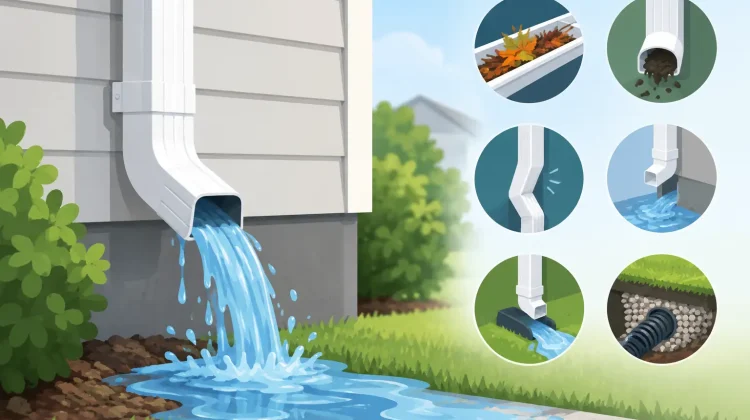
A downspout should carry roof runoff safely away from the building. When water spills over its top, gushes from a joint, or backs up through the gutter during a storm, it is more than an inconvenience. If you are asking, “why are downspouts overflowing,” the answer is usually a blockage, a drainage design issue, or a condition that has gradually worsened with weather and debris.
Overflowing downspouts can soak siding, stain masonry, wash out landscaping, and leave standing water near a foundation. For New Jersey and Staten Island properties, where heavy rain, falling leaves, and winter freeze-thaw cycles all affect drainage, addressing the cause early can prevent a much larger repair later.
Why Are Downspouts Overflowing During Rain?
The most common reason is simple: water cannot move through the downspout as quickly as it is entering the gutter. A clog is often responsible, but it is not the only possibility. The location and timing of the overflow can provide useful clues.
If water rises in the gutter and spills over the front edge before reaching the downspout opening, the gutter may be blocked, incorrectly pitched, undersized, or overwhelmed by roof runoff. If water pools at the downspout opening and comes back out of the gutter, the downspout itself is likely clogged. When water leaks or sprays from a seam halfway down the wall, loose connections, corrosion, or storm damage may be the issue.
A system that performs well in light rain but overflows in a hard storm may need a capacity review. Roof size, roof pitch, valley locations, and the number of downspouts all determine how much water the system must manage. A large or steep roof can send an enormous volume of water into one short gutter run in a matter of minutes.
Clogged Gutters and Downspouts
Leaves, seed pods, pine needles, roof grit, and nesting material can collect in gutters over time. Even a small pile of debris near the downspout outlet can act like a dam, slowing water until it backs up. In many cases, the visible debris in the gutter is only part of the problem. A compacted clog may be lodged inside the downspout, at an elbow, or where an underground drain begins.
Downspout clogs commonly occur at bends because debris catches there first. Wet leaves can break down into a heavy sludge that does not wash away on its own. During colder weather, trapped material can also hold water that freezes and restricts the passage even further.
Cleaning is the appropriate first step when the system is otherwise properly installed and in good condition. However, repeated clogging in the same location suggests that the gutter layout, outlet size, or debris protection strategy deserves closer attention. Gutter guards can reduce routine buildup, but they still need to be selected and installed for the roof type and debris conditions. No guard eliminates every maintenance need.
Poor Gutter Pitch Can Send Water the Wrong Way
Gutters need a slight, controlled slope toward each downspout. The pitch is subtle enough that it should not look noticeably crooked from the ground, but it is essential for drainage. If a gutter has settled, pulled away from the fascia, or was installed without the correct pitch, water can collect at the wrong end instead of flowing toward the outlet.
Standing water inside a gutter is a warning sign. Besides contributing to overflow, it adds weight that can strain hangers, loosen fasteners, and cause the gutter to sag. The issue may be limited to one section, especially after a storm or ice buildup, but a long-standing pitch problem can affect the entire run.
Rehanging and repitching may solve the problem when the materials are still sound. If the gutter is heavily corroded, repeatedly pulling loose, or has seams that continue to fail, replacement may be the better long-term choice. The right repair depends on the age of the system and the condition of the fascia behind it.
Too Few Downspouts or an Undersized System
Not every overflow is caused by neglect. Sometimes the drainage system was never sized for the building. Older homes, additions, and commercial properties may have long gutter runs served by too few downspouts. Roof valleys are another common trouble spot because they concentrate water from two roof planes into one area.
A downspout that is too small can become a bottleneck during heavy rainfall, even when it is clean. Likewise, a standard gutter may not have enough carrying capacity for a large roof area or a section that receives concentrated runoff. Water then moves faster than the outlet can handle and spills over.
Adding a downspout, increasing downspout size, installing a larger gutter profile, or revising the placement of outlets can improve performance. These changes should be planned around the structure rather than guessed at. The goal is not simply to move water off the roof. It is to direct it away from entryways, foundations, walkways, and neighboring properties without creating a new drainage problem at ground level.
Damaged Connections, Crushed Extensions, and Underground Drains
A downspout can overflow because its parts are no longer securely connected. Seams may separate, elbows can loosen, and fasteners may pull free over time. A dented or crushed section can restrict flow just as effectively as a debris clog. Look for water marks on siding directly below a joint, rust around fasteners, or sections that appear misaligned.
The discharge point matters as well. Extensions that are crushed, buried, or blocked by mulch can prevent water from exiting. If a downspout connects to an underground drainage line, the blockage may be below grade rather than in the visible portion of the system. Water may then back up during a storm and emerge at the upper connection.
Underground drain issues require a careful diagnosis. Forcing water into a blocked line can send it back toward the building or expose a hidden pipe failure. A contractor can determine whether the issue is a simple surface extension, a clogged leader line, or a drainage route that needs repair or redesign.
Ice, Snow, and Winter Overflow
Winter brings a different set of conditions. Ice inside the gutter or downspout can close off the water path completely. Melting snow from a warmed roof may then overflow behind or over the gutter, wetting soffits, siding, and areas near the foundation.
Ice does not always mean the gutter system is defective. It can be related to roof heat loss, snow accumulation, outdoor temperatures, and blocked drainage. Still, loose gutters, poor pitch, or recurring clogs can make winter overflow worse. Avoid striking frozen gutters or pulling aggressively on ice-filled downspouts, as this can bend the metal or tear fasteners from the fascia.
If winter overflow is recurring, it is worth evaluating both the gutters and the roof-edge conditions once temperatures allow. A durable solution may involve cleaning, repairs, better drainage capacity, or improvements to the conditions that encourage ice formation.
When an Overflowing Downspout Needs Professional Repair
Homeowners can safely clear light, reachable debris from the ground or a stable ladder when conditions allow. But overflowing gutters often involve work at roof level, and the cause is not always visible. It is time to call a gutter specialist when overflow continues after cleaning, gutters are sagging, water is reaching the foundation, or the same area fails in every major storm.
A professional inspection should look beyond the obvious clog. It should assess gutter pitch, hanger condition, outlet placement, downspout sizing, seams, fascia condition, and where discharged water ultimately goes. That approach helps avoid paying for repeated cleanings when a design correction is what the property actually needs.
Cavallari Gutters provides gutter cleaning support, repairs, replacements, gutter guard installation, and customized drainage solutions for homes and commercial properties in New Jersey and Staten Island. A properly functioning system should match the building’s roofline and water volume while maintaining a clean, finished appearance.
Overflow is your property’s warning that water is no longer following a controlled path. Address it before the next heavy rain, and the repair can protect far more than the gutter itself.



Leave a Reply