
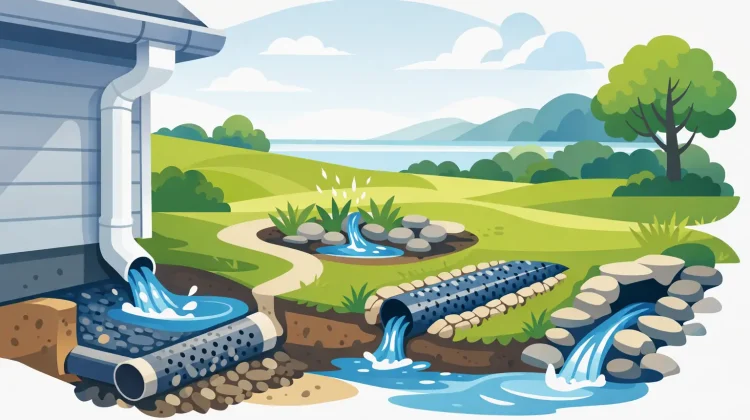
A gutter system can look fine from the street and still send hundreds of gallons of water to the worst possible spot – right next to your foundation. That is why downspout drainage solutions matter. If roof runoff is not carried far enough away from the building, you can end up with basement moisture, soil erosion, damaged landscaping, stained siding, icy walkways, and premature wear around the structure.
For homeowners and property managers in New Jersey and Staten Island, this is not a small maintenance detail. Heavy rain, wind-driven storms, and winter freeze-thaw cycles put a lot of pressure on drainage systems. A good setup does more than move water off the roof. It controls where that water goes after it leaves the downspout.
Why downspout drainage solutions matter
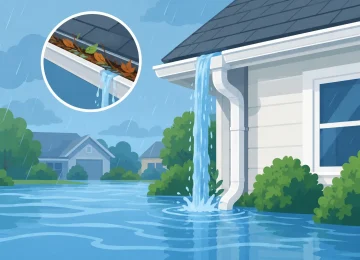
When gutters overflow, people usually assume the gutter itself is the problem. Sometimes that is true. Clogs, poor pitch, undersized gutters, or failing seams can all contribute. But in many cases, the bigger issue is what happens at ground level.
A downspout that empties too close to the home can oversaturate the soil around the foundation. Over time, that moisture can work its way into basements or crawl spaces, settle pavers and walkways, and create muddy areas that never seem to dry out. On commercial properties, poor drainage can also affect entrances, sidewalks, and customer-facing areas where appearance and safety matter.
That is why the right drainage solution should match the property, not just the gutter. Roof size, grading, hardscape layout, soil conditions, and available discharge areas all play a role.
Common signs your current drainage setup is not enough
Some drainage problems are obvious during the first hard storm. Others build slowly over time. If you notice water pooling near the foundation, trenching through mulch beds, peeling paint near lower siding, or washout around downspout discharge points, the system may be moving water off the roof without truly managing it.
You may also see mildew on foundation walls, recurring basement dampness, standing water near patios, or frozen patches in winter where runoff keeps collecting. These are all signs that the downspouts are discharging in the wrong place or not carrying water far enough away.
The most effective downspout drainage solutions
There is no single fix that works for every building. The best answer depends on how much water the roof collects and where the property can safely send it.
Downspout extensions
For many homes, the simplest improvement is a downspout extension. This adds length to the bottom of the downspout so water is discharged several feet away from the foundation instead of directly beside it.
This can be an effective and budget-friendly option when grading is decent and there is enough open lawn or planted area to absorb runoff. The trade-off is appearance and practicality. Above-ground extensions can get in the way of mowing, foot traffic, and routine landscaping. If they are too short, they will not solve the issue. If they are poorly placed, they can just move the problem from the foundation to the walkway.
Buried drain lines
When property owners want a cleaner look and more reliable control, buried drain lines are often the better choice. In this setup, the downspout connects to underground piping that carries water away to a safe discharge point.
This approach works well for tighter lots, finished landscapes, and properties where surface extensions would be inconvenient. It also helps reduce trip hazards and improves curb appeal. The key is proper installation. Underground lines need correct slope, suitable piping, and an outlet that does not back up during heavy rain. If the line has poor pitch or becomes blocked, the water has nowhere to go.
Splash blocks and discharge pads
A splash block sits at the bottom of a downspout and helps direct water away while reducing erosion at the outlet. It is a basic solution, but it can still be useful when paired with proper grading and modest roof runoff.
On its own, though, a splash block is usually not enough for larger roofs or recurring drainage issues. It is better thought of as part of a system than a complete answer.
Pop-up emitters
A pop-up emitter is often used at the end of a buried drain line. Water travels underground and releases through the emitter farther away from the structure, typically in a yard area that can handle the flow.
This can be a good-looking solution because most of the system stays out of sight. Still, it depends on having a suitable discharge area. If the yard is flat, poorly drained, or already saturated, the emitter location can become its own wet spot.
Drainage into storm systems, where permitted
On some properties, drainage can be tied into an approved stormwater system. This is highly dependent on local code, site conditions, and what is legally allowed. It is not a one-size-fits-all option, and it should never be improvised.
For commercial sites or larger residential properties, this may be part of the long-term answer, but it requires proper planning and compliance.
Matching the solution to the property
The right downspout drainage solutions start with a close look at the full water path. It is not enough to ask where the downspout ends. You also have to ask how much roof area feeds that downspout, what the ground does during a storm, and where the water can realistically go without causing another problem.
A home with strong natural slope may do well with carefully placed extensions or splash blocks. A property with a short side yard, patio space, and minimal drainage options may need buried piping. A commercial building with a wide roof span may need larger-capacity gutters and downspouts before any ground drainage upgrade will perform properly.
This is where experience matters. Good drainage planning means looking at the whole system, including gutter sizing, outlet placement, and how different parts of the property respond during heavy rainfall.
Don’t overlook gutter condition
Sometimes the downspout gets blamed for a problem that actually starts higher up. If the gutters are undersized, pulling away from the fascia, pitched incorrectly, or packed with debris, even a well-designed drainage extension will struggle.
That is why drainage work should be paired with an honest assessment of the gutter system itself. Clean flow from roof edge to outlet is the starting point. If water cannot reach the downspout efficiently, the discharge solution at the bottom will never be enough.
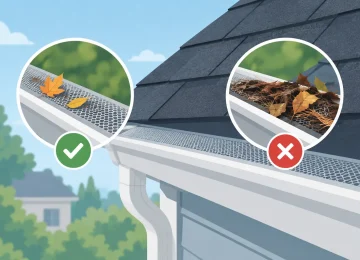
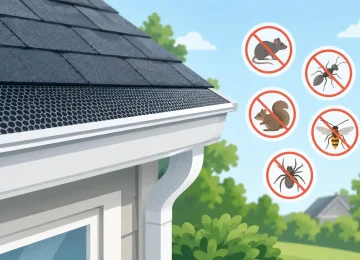
For properties with recurring debris buildup, gutter guards can also help reduce blockages and improve overall performance. They are not a cure-all, and they still need maintenance, but they can support a more dependable drainage system when the right product is chosen for the roof and tree coverage.
What property owners should avoid
One of the most common mistakes is using a short extension and assuming the problem is solved. In reality, runoff often needs to be carried much farther than expected, especially around foundations and hard surfaces.
Another mistake is draining water toward a neighbor’s property, a shared walkway, or an area that freezes in winter. Water has to leave the building safely, but it also has to be discharged responsibly. A quick fix that creates a bigger hazard somewhere else is not a real solution.
DIY underground piping can also go wrong fast. Without the right slope, fittings, and outlet planning, buried lines can trap debris, clog, or back up under pressure. Once that happens, the failure is hidden until water starts surfacing where it should not.
A practical approach for homes and buildings in this area
In this region, drainage has to hold up through summer storms, fall leaf buildup, and winter icing. That means durability matters as much as design. Property owners need solutions that fit the site, handle local weather, and support the long-term condition of the building.
Cavallari Gutters works with homeowners and commercial clients who need more than a quick patch. Whether the issue starts with gutter performance, downspout placement, or poor runoff control at ground level, the goal should always be the same: move water away from the structure in a controlled, dependable way.
If you are seeing erosion, pooling, overflow, or moisture near the building, it is usually cheaper to correct the drainage path now than to repair the damage later. The best next step is to look at the entire system and fix the part that is actually failing, not just the part that is easiest to see.
Water does not need much time to create a bigger problem. A properly designed drainage setup gives it a clear path away from your property – and gives you one less thing to worry about when the next storm rolls in.
Leave a Reply