
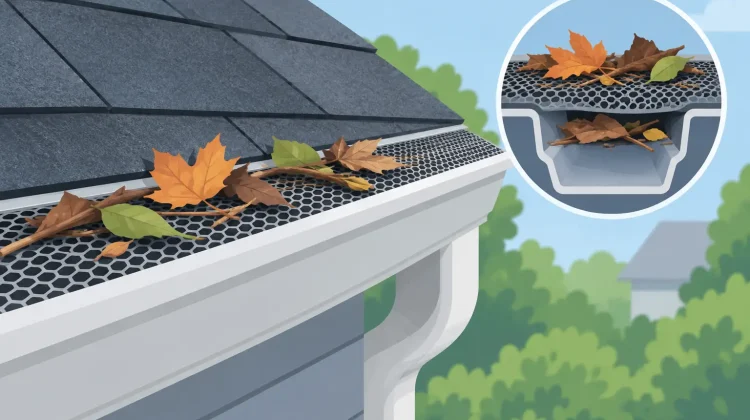
A gutter guard can keep a large volume of leaves out of the trough, but it cannot make debris disappear. So, can gutter guards trap debris? Yes, under certain conditions. Debris may collect on top of the guard, catch at the roof edge, or work its way into openings that are too large for the material falling around your property.
That does not mean gutter guards are a poor investment. It means the right guard, properly fitted to a sound gutter system, needs to be selected for the home or building. For property owners in New Jersey and Staten Island, where mature trees, heavy rain, wind-driven debris, and winter weather all affect roof drainage, that distinction matters.
Can Gutter Guards Trap Debris Inside the Gutter?
They can, especially when the guard type does not match the roofline or the debris load. A guard with wide openings may allow pine needles, seed pods, roof grit, and small pieces of organic matter into the gutter. Over time, that material can settle in corners, near outlets, and inside downspouts.
Even fine-mesh guards can collect debris if they are installed incorrectly or if water carries sediment through the mesh. Shingle grit is a common example. It is small enough to pass through many guard systems and can accumulate slowly at the bottom of the gutter.
More often, however, debris is trapped on top of the guard rather than inside the gutter. Wet leaves can cling to mesh. Pine needles can bridge across openings. Helicopter seeds can lodge in perforations. When the material dries, a breeze may clear some of it away. When it stays wet or is packed down by repeated storms, it may restrict water from entering the gutter.
The practical concern is not simply whether debris is present. The concern is whether the buildup changes the path of water. If rain runs over the front edge instead of into the gutter, it can soak siding, damage landscaping, stain masonry, and contribute to foundation moisture problems.
Why Debris Gets Caught on Gutter Guards
Gutter guards work by separating water from larger debris, but roof runoff is not always neat. During a hard storm, water moves quickly down the roof and carries leaves, twigs, granules, and dirt with it. A guard has to accept that volume of water while shedding the debris away.
Several conditions make buildup more likely:
- Trees that drop fine needles, small leaves, flowers, seeds, or sticky pollen can challenge almost any guard design.
- Low roof pitches or roof valleys can send concentrated streams of water toward one section of gutter.
- A gutter that is undersized, improperly pitched, or already holding standing water will not perform well with or without guards.
- Loose shingles, aging roofing materials, and moss growth can add grit and organic matter to the drainage system.
- Heavy snow and ice can shift guards, bend gutter sections, or create areas where debris catches more easily.
Roof valleys deserve special attention. A valley concentrates runoff from two roof planes into a small area. If that stream lands directly on a guard, leaves and granules can pile up faster than normal rain can wash them away. In some cases, a professional may recommend a diverter, a wider gutter, an adjustment to the outlet layout, or a different guard style for that area.
Not All Gutter Guards Handle Debris the Same Way
There is no single best guard for every property. The material around the building, roof design, gutter size, and local weather all affect the recommendation.
Screen and perforated guards
Screen-style and perforated guards have larger openings than micro-mesh products. They can handle larger leaves well and often allow strong water flow, but small debris may enter through the holes. They are generally a better fit where broad leaves are the main issue, rather than pine needles or heavy seed fall.
Fine-mesh guards
Fine-mesh guards block much smaller debris and are often a strong option for homes surrounded by pine trees or other fine-dropping vegetation. The trade-off is that fine material can rest on top of the mesh, particularly when it is wet. Periodic surface cleaning may still be needed to keep water moving freely.
Reverse-curve and surface-tension guards
These systems are designed to guide water around a curved edge while leaves fall away. They can work well in the right setting, but installation angle and roof runoff are critical. If the pitch is wrong or the roof sends too much water toward one area, water may overshoot the gutter during heavy rain.
Foam and brush inserts
Foam and brush products sit inside the gutter rather than covering it. They are often less expensive upfront, but they can hold organic material within the gutter channel. As debris breaks down, it can become difficult to remove and may affect drainage. For long-term property protection, many homeowners prefer a guard system that keeps the gutter interior more accessible and clear.
Gutter Guards Reduce Cleaning, Not Maintenance
A common misunderstanding is that gutter guards make maintenance unnecessary. A quality guard system can greatly reduce how often gutters need to be cleaned, but every exterior drainage system deserves inspection.
A good schedule is to check the roofline and gutters after the heaviest leaf drop, after major windstorms, and before periods of freezing weather. From the ground, look for water spilling over the gutter edge, dark streaks on the fascia, sagging sections, or downspouts that discharge weakly during rain. These signs can point to a clog, trapped debris, a pitch issue, or a loose guard section.
For commercial properties and multi-unit buildings, inspections are even more important. A blocked drainage path can affect entrances, walkways, parking areas, exterior walls, and tenant spaces. Maintenance planning helps property managers address minor buildup before it becomes an emergency repair.
Avoid climbing a ladder or walking on a roof if you are not equipped to do so safely. Cleaning support and a professional inspection are the safer choice when guards are high, the roof is steep, or the system has visible damage.
Proper Installation Makes the Difference
The best gutter guard will not correct a failing gutter system. Before guards are installed, the gutters should be securely fastened, correctly sloped, and free of existing buildup. Downspouts need enough capacity to carry water away from the structure, and outlets should not be restricted.
Installation also has to respect the roof edge. Guards that are poorly attached can lift in wind, interfere with shingle edges, create gaps, or direct water behind the gutter. That can lead to fascia rot and hidden wood damage, which is exactly what a gutter system is meant to help prevent.
A professional gutter specialist looks at more than the guard itself. They assess the roof pitch, valleys, nearby trees, gutter size, downspout placement, and areas where water has previously overflowed. On some properties, the right answer may include gutter repair or replacement before adding guards. On others, a targeted guard installation over the worst debris-prone sections is more practical than covering every run.
When Gutter Guard Buildup Calls for Service
Some debris on a guard is normal. The time to schedule service is when you see water bypassing the gutter, plant growth along the roofline, frequent overflow, sagging sections, loose guard panels, or water pooling near the foundation.
Do not wait for a stain on the ceiling or a washed-out flower bed to confirm there is a drainage problem. Gutters direct thousands of gallons of water away from a property over the course of a year. When that path is blocked, water finds another route, often along siding, behind trim, or toward the foundation.
Cavallari Gutters can evaluate the condition of the gutter system and recommend a practical solution based on the property, not a one-size-fits-all sales pitch. That may mean cleaning and resecuring existing guards, repairing a damaged section, improving drainage capacity, or installing guards that better match the debris around the building.
The right gutter guards should make ownership easier, not create a false sense of security. With proper sizing, careful installation, and occasional inspection, they can reduce debris problems while helping protect the roofline, exterior, and foundation for years to come.


Leave a Reply