
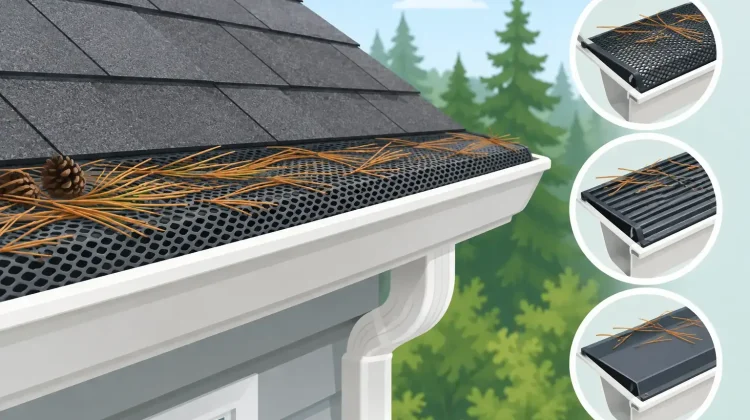
A gutter can look clear from the ground and still be collecting the debris that causes the next overflow. Pine needles are especially difficult because they are narrow enough to pass through many openings, yet they can mat together inside a gutter and slow water flow. Pine needle guards can make maintenance more manageable, but only when the guard, gutter, roofline, and surrounding trees are evaluated as one drainage system.
For homeowners and property managers in New Jersey and Staten Island, the goal is not simply to put a cover over the gutter. It is to keep rainwater moving away from the roof, siding, foundation, walkways, and landscaping during the storms that put the system under real pressure.
Why Pine Needles Create a Different Gutter Problem
Broad leaves often sit on top of a gutter guard, where wind or rain can move them along. Pine needles behave differently. They can slide into larger guard openings, cling to wet surfaces, and collect along the edge of a screen or hood. Once enough needles gather, they trap shingle grit, seed pods, roof moss, and other fine debris.
That buildup may not create an immediate blockage. Instead, it can gradually reduce capacity until a heavy rain exposes the problem. Water may spill over the gutter lip, run behind the fascia, or bypass the downspout because debris has gathered at the outlet. On commercial properties, a partially clogged drainage system can also create avoidable maintenance concerns around entrances, paved areas, and exterior walls.
The amount of debris matters, but so does the type of pine tree, its distance from the roof, and the direction of prevailing winds. A home with one mature pine near a low roof section has different needs than a property surrounded by evergreens.
Do Pine Needle Guards Actually Work?
The short answer is yes, with realistic expectations. A properly selected and installed guard can significantly reduce the amount of debris entering a gutter. It will not make every gutter permanently maintenance-free, particularly on a heavily wooded lot.
The best guard for pine needles usually has small, consistent openings that block needles while allowing water to enter. It also needs enough drainage capacity for local rainfall and a secure fit that does not interfere with shingles, roof flashing, or the gutter’s slope. A guard that filters needles effectively but sends water over the front edge during a downpour is not protecting the property.
Even a quality installation requires occasional inspection. Needles and pollen can settle on top of fine screens, and debris can accumulate in roof valleys above the gutter. The difference is that maintenance is generally lighter, safer, and less frequent than cleaning open gutters packed with debris.
Types of Pine Needle Guards to Consider
Fine Micro-Mesh Guards
Fine micro-mesh is often a strong choice for properties with pine needles because the openings are small enough to keep out many fine debris types. Water passes through the mesh while needles tend to remain on the surface. The performance depends on mesh quality, the support beneath it, the pitch of the roof, and the way the guard is fitted to the gutter.
A fine mesh can collect pollen, shingle granules, and residue over time. It may need brushing or rinsing to maintain flow, especially below pine-heavy rooflines. Still, for many homes, this trade-off is preferable to repeated gutter cleanings and clogged downspouts.
Perforated Aluminum Guards
Perforated guards use holes rather than woven mesh. They are durable and can handle larger leaf debris well, but the hole size is critical. If openings are too large, pine needles may enter the gutter. If they are very small, surface debris may need more regular attention.
These guards can be a sensible option where tree cover is moderate rather than extreme. They also need to be fastened correctly so they remain stable through wind, snow, and seasonal temperature changes.
Reverse-Curve or Surface-Tension Guards
Surface-tension systems are designed to guide water around a curved edge and into the gutter while debris falls away. They can work well with larger leaves, but pine needles may catch along the leading edge or under the curve, depending on the roof and nearby trees.
These systems also require careful installation because alignment affects performance. They are not automatically the best answer for every pine-covered property, especially where roof valleys release a concentrated volume of water.
Basic Screens and Foam Inserts
Basic screens are often less expensive, but many versions have openings large enough for needles to get through. They can still reduce larger debris, though they may not solve the fine-debris issue that prompted the project.
Foam inserts sit inside the gutter and allow water through the porous material. Over time, needles, roof grit, and organic matter can become embedded in the foam. They may be useful in limited situations, but they are generally not the first choice for long-term pine needle control.
The Guard Is Only Part of the Solution
A gutter guard cannot correct an undersized, damaged, or poorly pitched gutter system. Before adding protection, the system should be evaluated for sagging sections, loose hangers, separated seams, improper slope, and downspout capacity. Water needs a clear route from the roof edge to a properly placed discharge area.
Roof design also matters. Steep roofs can send water down with more force. Valleys concentrate runoff into a small section of gutter. Long roof runs may need larger gutters or additional downspouts to prevent overflow. If a guard is installed without addressing these conditions, the property owner may still see water spilling over during storms and assume the guard has failed.
This is why a professional evaluation should include more than a recommendation based on the trees in the yard. It should consider the building’s drainage demands, roof geometry, existing gutter condition, and the areas where water has caused trouble in the past.
Signs Your Property May Need Pine Needle Protection
Frequent cleaning is the most obvious sign, but it is not the only one. Needles packed near downspout openings, water marks on siding, mulch washed out below the roofline, or water dripping behind the gutter can all point to debris-related drainage issues.
Look closely after a steady rain. Overflow at one corner may indicate a blocked downspout or a low gutter section. Water running over the entire front edge may suggest a capacity issue, a guard problem, or a roof valley delivering more runoff than the current system can handle. These details help determine whether a guard installation alone is appropriate or whether repairs or replacement should come first.
Property managers should also watch for recurring complaints at entryways and lower roof sections. Keeping drainage controlled helps protect both the building exterior and the people using the property.
Installation Quality Makes a Real Difference
Gutter guards are often sold as a simple add-on, but the workmanship behind the installation matters. Guards should be secured without creating unnecessary penetrations in the roof. They should not lift shingles, obstruct flashing, or create a low point where water and debris collect. The gutter itself must be properly fastened and pitched toward the downspouts.
A professional installer can also identify sections that need cleaning, resealing, rehanging, or replacement before guards are added. Covering an existing problem may hide it temporarily, but it does not protect the fascia or foundation when the next heavy storm arrives.
Cavallari Gutters approaches guard recommendations as part of the full water-management picture. The right solution should fit the property, perform through changing seasons, and be installed with the same attention given to the gutters underneath it.
Maintenance Still Protects Your Investment
Even with effective pine needle guards, plan on periodic visual checks. Inspect the roofline after major storms, during the fall, and after periods of heavy pollen or needle drop. Look for debris resting along the guard surface, water flowing over the gutter, and downspouts that are draining slowly.
Keep roof valleys clear when it is safe to do so, and make sure downspout extensions direct water away from the foundation. If you are not comfortable working at height, schedule professional cleaning and inspection rather than risking a ladder fall or overlooking damage at the roof edge.
The right guard should reduce the time you spend worrying about clogged gutters, not give you a reason to ignore drainage altogether. A well-maintained system keeps doing its quiet job: moving water away from the places where it can cause expensive damage.



Leave a Reply