
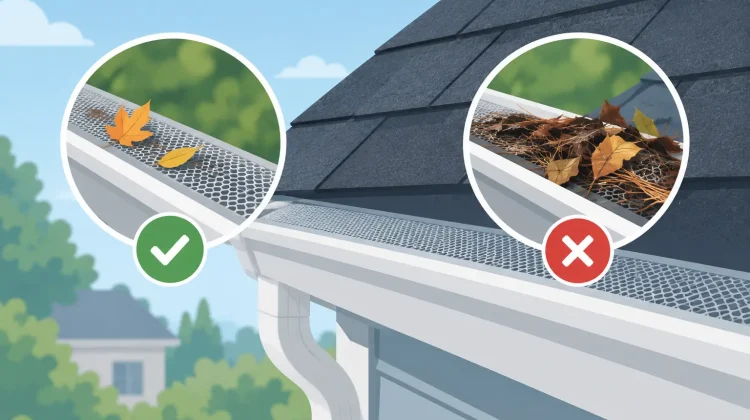
A gutter guard should make maintenance easier, not create a hidden drainage problem. So, do gutter guards clog? They can, but a properly selected and professionally installed guard greatly reduces the debris that reaches the gutter channel. The key is understanding that guards are not a promise of zero maintenance. They are a practical way to reduce cleaning frequency, improve water flow, and help protect your roofline, siding, foundation, and landscaping.
For homeowners and property managers in New Jersey and Staten Island, the answer often depends on the trees around the building, the roof design, the condition of the existing gutters, and the type of guard installed. A system that works well on one property may need a different approach on another.
Do Gutter Guards Clog? Yes, but Not in Every Way
Gutter guards can collect debris on top of their surface. Fine mesh styles may catch pine needles, shingle grit, seed pods, and wet leaves before those materials enter the gutter. In heavy rain, most debris washes away or dries and blows off. But when debris is packed down by repeated storms, it can form a layer that slows water from entering the system.
That is different from a traditional gutter clog. Without guards, leaves and debris can settle inside the gutter, block the outlet, and lodge in the downspout. Those clogs are often harder to spot and can cause water to overflow quickly. With an appropriate guard, debris is more likely to remain visible at the top, where it can be removed during routine service.
No guard can overcome an undersized gutter, an incorrectly pitched run, a downspout that is too small, or a roof valley that sends a concentrated rush of water into one spot. Guards work best as part of a complete drainage system, not as a substitute for proper installation and repair.
What Causes a Gutter Guard to Clog?
The most common issue is not the guard itself. It is a mismatch between the guard, the property, and the debris load. Homes near mature oaks, maples, pines, or flowering trees may see different debris throughout the year. Large leaves behave very differently than pine needles or small helicopter seeds.
Fine debris can also become sticky after a wet season. Pollen, roof granules, dirt, and decomposing leaf material may cling to a guard surface, especially in shaded areas where moisture lingers. Over time, that buildup can limit water entry if it is not cleared away.
Roof design matters as well. Steep roof slopes and long roof planes move water quickly. Valleys concentrate runoff, sometimes carrying leaves and granules with it. If the gutter is not sized and positioned for that volume of water, even a high-quality guard may appear to be failing during a severe storm.
Installation details make a major difference. Guards must sit securely, align correctly with the roof edge, and allow water to enter rather than overshoot the gutter. Damaged fascia, loose hangers, sagging gutters, or improperly placed downspouts should be addressed before or during guard installation. Installing guards over an existing problem only hides it temporarily.
The Type of Guard Makes a Difference
There is no single gutter guard that is ideal for every property. The best choice depends on the roof, gutter size, nearby trees, and maintenance expectations.
Screen guards have larger openings and can stop leaves and larger debris. They are often a practical option where large leaves are the main concern, but small debris may still get through. They may also require more attention around pine trees or properties with heavy seed fall.
Micro-mesh guards use much smaller openings. They are effective at keeping fine debris out of the gutter channel, which can be especially helpful near pine needles and roof grit. Because they filter smaller material, their top surface should still be inspected and cleaned as needed.
Reverse-curve and surface-tension designs direct water around a curved edge while encouraging debris to fall away. Their performance can depend heavily on roof pitch, rainfall intensity, and the quality of the installation. In the wrong application, fast-moving water may overshoot the gutter.
Brush and foam inserts are generally less effective for long-term debris control. Debris can become embedded in the material, and the inserts may be difficult to clean thoroughly. They can be a short-term solution in some cases, but they do not offer the same level of protection as a well-fitted guard system.
A gutter specialist should evaluate these trade-offs before recommending a product. The goal is not to sell the most complicated option. It is to build a drainage solution that handles the conditions at your specific property.
Signs Your Gutter Guards Need Attention
A quick visual check after a major storm can help catch issues early. Water spilling over the front of the gutter, streaks on siding, pooling near the foundation, or dripping behind the gutter can all point to a drainage concern.
You may also notice plants growing from the gutter edge, debris resting in thick piles on top of the guards, or water backing up near roof valleys. These signs do not always mean the guards need replacement. Often, the system needs cleaning, a minor adjustment, or a downspout inspection.
Commercial properties and multi-unit buildings deserve particular attention because neglected drainage can affect more than one entrance, facade, or landscaped area. A maintenance plan is often more cost-effective than waiting for overflow to cause damage or create slippery walkways.
How to Keep Gutter Guards Working Properly
Even the best guard system benefits from occasional care. Most properties should have gutters and guards checked at least once or twice per year, usually after the heaviest leaf drop and after seasons with significant storms. Buildings surrounded by pine trees or dense mature landscaping may need more frequent service.
During an inspection, the important work goes beyond brushing off the top surface. The gutter channel should be checked for trapped material, downspouts should be tested for clear flow, and the system should be examined for loose fasteners, improper slope, leaks, and fascia damage. Water should move through the entire system and discharge far enough away from the foundation.
Avoid treating gutter guards as a safe surface for walking or leaning ladders against. They can be bent, pulled loose, or damaged by improper access. If your roof is steep, your gutters are high, or you already see overflow, professional service is the safer choice.
When Gutter Guards May Not Be the First Fix
If gutters overflow during every hard rain, guards may not be the main issue. The gutter system may be too small for the roof area, especially on larger homes, commercial buildings, or roof sections with heavy valley runoff. A larger gutter profile, additional downspouts, or better drainage routing may be necessary.
Likewise, if gutters are old, rusted, separated at the seams, or pulling away from the fascia, installing guards first is rarely the best investment. Repairing or replacing the gutter system creates a stable foundation for guard installation and helps ensure the warranty and performance of the new work.
A professional assessment can separate a simple debris issue from a larger water-management problem. That matters because overflow is not just an inconvenience. Repeated water exposure can damage trim, stain siding, erode soil, and increase the risk of moisture problems near the foundation.
A Better Expectation for Gutter Guard Performance
The right expectation is not that gutter guards eliminate every leaf or remove the need to ever look at your gutters again. A quality system should keep most debris out of the gutter and downspouts, reduce the need for frequent cleaning, and make necessary maintenance simpler and safer.
Cavallari Gutters helps property owners evaluate the full condition of their drainage system before recommending gutter guard installation. With the right product, correct sizing, secure installation, and periodic cleaning support, gutter guards can be a reliable part of protecting your property from water damage.
If you are seeing overflow, recurring clogs, or debris collecting around your roofline, address it before the next heavy storm turns a manageable maintenance need into a repair issue.



Leave a Reply