
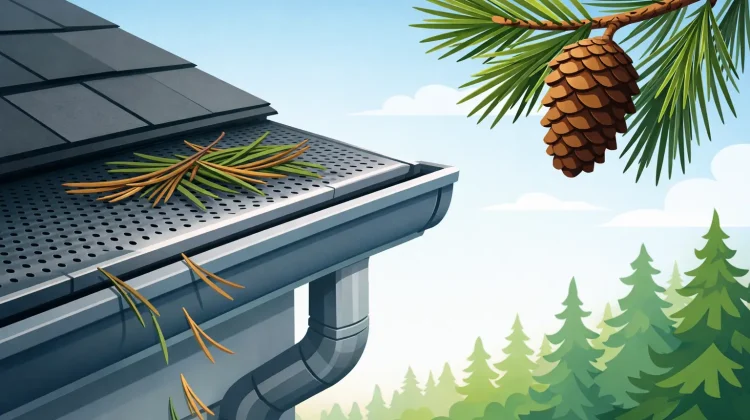
If you have pine trees near your home, you already know standard gutter protection is not always enough. The best gutter guards for pine needles need to do more than block big leaves. They need to handle thin, stubborn debris that mats together, slips into openings, and creates clogs that can lead to overflow, fascia damage, foundation issues, and constant cleaning.
Pine needles are one of the hardest debris types for any gutter system to manage. They are light, narrow, and quick to collect in valleys, downspouts, and guard openings. In New Jersey and Staten Island, where storms, wind, and seasonal buildup can put extra stress on drainage systems, choosing the right guard matters just as much as choosing the right gutter.
Why pine needles are so hard on gutters
Leaves tend to sit on top of a gutter guard and dry out or blow away. Pine needles behave differently. They can lie flat, slide with rainwater, and gather into dense layers that trap moisture and finer debris like shingle grit. Once that happens, water stops moving the way it should.
This is where many homeowners get frustrated. A guard may work well in a broadleaf neighborhood and still perform poorly under pine trees. That does not always mean the product is defective. It often means the guard opening, slope, installation method, or gutter condition is not suited for the type of debris on that property.
What to look for in the best gutter guards for pine needles
The main thing to focus on is opening size. If the holes, slots, or gaps are wide enough for pine needles to enter, eventually they will. Fine stainless steel micro-mesh systems usually perform better than guards with larger perforations or wide surface openings because they keep out thinner debris while still allowing water through.
Material quality also matters. A guard that sags, warps, or separates from the gutter line can create collection points where needles gather. Aluminum frames and stainless steel mesh tend to hold up better over time than lighter plastic systems, especially in areas with changing temperatures and storm exposure.
Installation detail is just as important as the product itself. Even a strong guard can underperform if it is pitched incorrectly, tucked poorly under roofing materials, or installed over damaged gutters. Water management is a system, not a single part.
Which gutter guard styles work best
Micro-mesh gutter guards
For most properties dealing with pine debris, micro-mesh is the strongest option. The fine screen is designed to keep out small debris while letting rainwater pass through the surface. When installed properly, this style can significantly reduce pine needle intrusion compared with basic screen or reverse-curve products.
That said, micro-mesh is not maintenance-free. Needles, pollen, and roof granules can build up on top over time, especially if the roof pitch is low or tree coverage is heavy. In those cases, occasional brushing or professional cleaning may still be needed to keep water flowing at full capacity.
Surface tension or reverse-curve guards
These guards are built to move water around a curved edge and into the gutter while debris falls off. They can work in some environments, but pine needles are often a weak point. Because the debris is long and thin, it may follow the water path into the gutter or collect at the nose of the guard.
They also tend to rely heavily on precise installation and adequate water flow conditions. During heavier storms, some systems may overshoot if they are not matched properly to roof pitch and runoff volume.
Basic screens and perforated covers
These are common because they are affordable and widely available. For pine needles, they are usually not the best long-term answer. Openings are often too large to stop thin debris, and once needles get inside, cleaning becomes more difficult because the cover is in the way.
In lighter debris conditions, a perforated system may be good enough. Under mature pines, it often turns into a compromise that still leaves the property owner dealing with seasonal clogs.
Foam inserts and brush guards
These are usually the least reliable choices for pine needles. Foam can trap debris on top or within the insert itself, and brush-style guards tend to catch needles rather than shed them. They may help short term, but they generally create more maintenance, not less.
Best gutter guards for pine needles depend on the whole system
A lot of articles make this sound simple: pick a guard and the problem is solved. In the field, it is rarely that clean. The best gutter guards for pine needles depend on gutter size, downspout placement, roofline design, tree coverage, and whether the existing system is still structurally sound.
For example, if a home has undersized gutters, a guard alone will not fix overflow during storms. If downspouts are clogged or poorly placed, water can back up no matter how advanced the guard is. If gutters are loose, holding standing water, or pulling away from the fascia, debris protection should not be installed until the base system is corrected.
That is why a professional evaluation matters. The right recommendation should be based on drainage performance, not just a product brochure.
Common mistakes homeowners make
One of the biggest mistakes is choosing based on marketing claims like never clean your gutters again. No gutter guard completely eliminates maintenance, especially around pine trees. A good guard reduces labor, lowers clog risk, and improves drainage reliability. It does not make the system immune to buildup forever.
Another mistake is installing guards over neglected gutters. If there is hidden damage, improper pitch, loose fasteners, or existing debris packed into downspouts, covering the system can make future problems harder to spot. Cleaning and inspection should come first.
Price-only decisions also create trouble. Lower-cost products can be tempting, but if they fail under pine debris, the homeowner may end up paying again for removal, replacement, repairs, or water damage mitigation. The cheapest option is not always the least expensive one over time.
What property owners in New Jersey and Staten Island should consider
Local weather matters. Heavy rain, wind-driven storms, winter freeze-thaw cycles, and seasonal debris loads can all affect how a gutter guard performs. A system that looks fine in mild conditions may struggle during a summer downpour or after a week of windy weather.
Tree density matters too. A house with a few nearby pines may do well with a different solution than a property fully surrounded by mature evergreens. Commercial and mixed-use buildings also need to account for roof area, runoff volume, and maintenance access.
For many local properties, the best approach is a professionally fitted micro-mesh guard paired with properly sized gutters and a realistic maintenance plan. That combination tends to provide better long-term performance than a one-size-fits-all product chosen off the shelf.
When replacement makes more sense than adding guards
Sometimes the conversation should start with the gutters themselves. If the current system is rusted, sagging, leaking at seams, or too small for the roof, adding guards may only delay a larger problem. New guards perform best when they are installed on gutters that are secure, correctly pitched, and sized for the building.
This is especially true for older homes or commercial properties that have had repeated overflow issues. In those cases, upgrading the gutter system and adding the right protection at the same time usually leads to better results and fewer service calls.
Professional installation versus DIY
Some homeowners are comfortable with DIY projects, but gutter guards for pine needles are one area where installation quality can make a major difference. Small gaps, uneven fastening, poor transitions at corners, and improper integration with the roof edge can all reduce performance.
Professional installation also helps avoid damage to shingles, fascia, and existing gutters. More importantly, it gives the property owner a better chance of ending up with a system that is matched to the home instead of a product that just happened to be available. Companies like Cavallari Gutters approach this as a drainage solution, not a box product.
A smarter way to choose
If you are comparing options, ask practical questions. What kind of debris is the system designed to handle? How does it perform in heavy rain? Will it sit securely on your current gutters? What maintenance should you realistically expect each year? A dependable contractor should answer those clearly and without overselling.
The right gutter guard should reduce cleaning frequency, protect the structure, and give you more confidence during storms. Around pine trees, that usually means looking past the cheapest screen and focusing on a well-installed, high-quality system built for fine debris.
When water is supposed to move away from your property, every detail matters. A good gutter guard helps, but the real goal is a gutter system that keeps doing its job when the weather and the trees are working against it.


Leave a Reply