

Leaves do not need much time to create a problem. One windy afternoon, one heavy rain, and a gutter system that looked fine last week can start overflowing at the corners, spilling near the foundation, and staining siding. That is why many property owners ask whether gutter guards reduce cleaning enough to be worth the investment. In many cases, they do – but the real answer depends on the type of debris around the building, the condition of the existing gutters, and whether the system is sized and installed correctly.
Do gutter guards reduce cleaning?
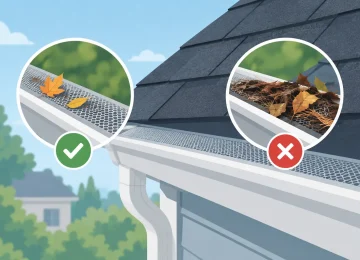
Yes, gutter guards reduce cleaning by limiting how much debris enters the gutter trough in the first place. Instead of allowing leaves, sticks, seed pods, and roof grit to collect freely, guards create a barrier that helps water move through while keeping larger debris out.
That does not mean maintenance disappears. It means the nature of the maintenance changes. Instead of repeated full cleanouts of packed, wet debris inside the gutters, most properties with a well-matched guard system need lighter upkeep, such as clearing the top surface, checking downspouts, and making sure water is flowing as intended.
For homeowners and property managers, that difference matters. Less buildup usually means fewer clogs, fewer overflow events, and less need to schedule emergency service after a storm.
Why less gutter cleaning matters beyond convenience
Most people first think about gutter cleaning as a chore. In reality, it is also a property protection issue. When gutters clog, water can back up under roof edges, spill down fascia boards, wash out landscaping, and pool near the foundation.
On commercial properties and multi-unit buildings, the stakes can be even higher. Overflow near walkways can create slippery conditions. Constant runoff against siding or masonry can leave staining and contribute to long-term exterior wear. For property managers, fewer clogs can also mean fewer tenant complaints and fewer surprise maintenance calls during bad weather.
This is where gutter guards can make practical sense. Their value is not just in saving time on ladder work. It is in helping the entire drainage system perform more consistently.
How gutter guards reduce cleaning in real conditions
A guard works by controlling what enters the gutter. That sounds simple, but performance depends on matching the product to the site.
In neighborhoods with large deciduous trees, the main problem may be broad leaves that quickly mat together inside open gutters. A properly fitted guard can keep most of that debris out, so water keeps moving to the downspouts instead of spilling over the front edge.
In other areas, pine needles, maple helicopters, or fine roof granules may be the bigger issue. Those conditions require more careful product selection because some guard styles handle larger debris better than finer material. If the wrong guard is installed, cleaning demands may improve only slightly.
The pitch of the roof, the volume of runoff, and the condition of the fascia also matter. If a gutter is loose, undersized, or incorrectly sloped, adding a guard alone will not fix the underlying drainage problem. In that situation, guards may reduce some debris entry, but the system can still overflow because the structure of the gutter system is the real issue.
Gutter guards are not a no-maintenance product
This is one of the most important points for property owners to understand. Gutter guards reduce cleaning, but they do not eliminate maintenance.
Debris can still collect on top of the guard. Pollen, roof grit, and small organic matter can still build up over time. Downspouts still need to be checked. After strong storms, it is smart to inspect the system for anything that may be blocking water flow.
That is not a drawback so much as a realistic expectation. A good gutter guard system should lower the frequency and intensity of cleaning, not create the false impression that the gutters never need attention again. Reliable contractors are usually straightforward about that because long-term performance depends on honest planning, not sales language.
The types of properties that benefit most
Single-family homes with mature trees are often strong candidates because open gutters in these settings can fill quickly, especially in fall and during spring storms. Guards can cut down on repeated seasonal cleanouts and reduce the chances of water spilling near entryways, patios, and foundation beds.
Commercial properties can also benefit, particularly when maintenance access is difficult or when clogging creates visible overflow at storefronts or along heavily traveled areas. On mixed-use buildings and rental properties, reducing debris buildup can help stabilize routine maintenance and protect exterior finishes.
Even so, not every building needs the same solution. A property with minimal tree cover may not need guards as urgently as one surrounded by heavy leaf drop. That is why a site-specific evaluation matters more than a one-size-fits-all recommendation.
When gutter guards may not solve the whole problem
Sometimes customers assume guards are the answer when the actual problem is damaged or outdated gutters. If seams are leaking, hangers are failing, or the gutters are too small for the roof area, debris reduction alone will not restore proper drainage.
The same is true when downspouts are undersized or poorly placed. Water has to move through the full system, not just into the trough. A guard can help keep out debris, but it cannot compensate for poor layout or worn components.
That is why professional installation matters. A contractor who specializes in gutter systems should look at more than the top opening. They should assess pitch, attachment, capacity, drainage path, and how the gutter ties into the building’s larger water management needs.
Installation quality affects cleaning reduction
The phrase gutter guards reduce cleaning is true only when the system is installed properly and paired with a gutter that is already functioning as it should. Gaps, poor fastening, misalignment at the roof edge, or the wrong guard style can all reduce performance.
In some cases, a poorly installed guard can create new issues, such as water overshooting the gutter during heavy rain or debris getting trapped in difficult-to-reach sections. That is why material quality and workmanship matter as much as the idea of adding a guard in the first place.
For property owners in New Jersey and Staten Island, seasonal weather adds another layer to the decision. Heavy rain, coastal conditions, leaf drop, and winter freeze-thaw cycles put real stress on drainage systems. A guard solution should be chosen with those local conditions in mind, not just based on a generic product claim.
What to expect after installation
Most customers notice one main change first: the gutters do not fill up with visible debris nearly as fast. That usually means fewer full cleanings each year and less concern after windy weather.
Over time, the bigger advantage is consistency. Water moves where it is supposed to move more often, and the property sees fewer nuisance issues tied to gutter blockage. That can mean less staining, less overflow near landscaped areas, and fewer warning signs around soffits and fascia.
A reputable gutter specialist will usually recommend occasional inspection anyway. That keeps small issues from turning into expensive ones and gives you a clearer picture of how the guards are performing under real conditions.
Is it worth it?
If your current gutters clog regularly, require frequent cleaning, or overflow during routine storms, guards are often worth serious consideration. The return is usually measured in reduced maintenance, better drainage reliability, and less exposure to water-related exterior damage.
If your gutters are rarely affected by debris, the value may be more limited. In that case, the better investment might be repair, resizing, or improving downspout layout. It depends on the building, the surroundings, and the condition of the system you already have.
At Cavallari Gutters, that practical approach matters because the right recommendation is the one that protects the property, not just the one that adds a product. Gutter guards can be a smart upgrade, but they work best when they are part of a well-built drainage system backed by proper installation and clear follow-through.
If you are tired of repeated cleanings or worried about overflow around your home or building, the best next step is not guessing. It is having the system looked at by someone who understands how gutters are supposed to perform when the weather turns rough.


Leave a Reply