

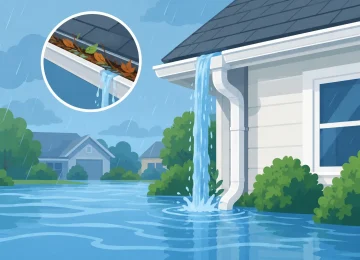
A gutter system usually gets ignored until water starts pouring over the edge like a waterfall. When you see gutters overflowing in heavy rain, the issue is rarely just the storm itself. In most cases, the rain is exposing a drainage problem that was already there.
That matters because overflow is not just an annoyance. Water spilling over the sides of gutters can soak fascia boards, stain siding, flood planting beds, wash out soil, and put extra moisture near the foundation. On commercial properties, it can also create slippery walkways, splashback on storefronts, and ongoing maintenance headaches that cost more over time.
What causes gutters overflowing in heavy rain?
The most common cause is blockage. Leaves, twigs, shingle grit, and roof debris collect inside the trough and at the downspout openings. During a light shower, water may still move through slowly enough that the problem goes unnoticed. In a hard storm, that restriction becomes obvious and water backs up fast.
The second common issue is pitch. Gutters need the right slope to guide water toward the downspouts. If they are too flat, sagging in the middle, or pulling away from the fascia, water can sit in sections instead of moving out. Once enough rain hits the roof, the standing water has nowhere to go except over the front edge.
Size can also be part of the problem. Not every gutter system is built for the roof area it serves. A larger roof plane sends a surprising amount of water into the gutters in a short period of time. If the gutter profile is too small or there are not enough downspouts, even a clean system may struggle during a strong storm.
Then there is the condition of the system itself. Seams can separate, spikes can loosen, hangers can fail, and older metal can warp. If the gutter line is no longer straight and secure, water flow becomes uneven. What looks like a rain problem may really be a worn-out system that has lost its proper shape.
Heavy rain is the test, not always the root cause
Property owners sometimes assume overflow only happens because the storm was unusually intense. Sometimes that is true. New Jersey and Staten Island can see sudden downpours that push any drainage system hard. But if the same areas overflow again and again, the better question is why the system cannot handle the volume it should be handling.
A properly designed and maintained gutter system should manage typical heavy rain for that property. If it does not, there is usually a fixable reason. It could be cleaning, a targeted repair, an added downspout, a larger gutter profile, or a full replacement depending on the age and design of the system.
This is where experience matters. The right solution depends on what is failing. Cleaning a system with poor pitch will not solve the long-term issue. Replacing one loose section will not help much if the entire run is undersized. On the other hand, a full replacement is not always necessary if the core system is still sound and the problem is isolated.
Signs the problem is more than debris
Overflow does not always mean the gutters are packed solid. If you have had them cleaned and they still spill over, it is time to look deeper.
Watch for water pouring over one section more than others. That often points to an alignment issue, a low spot, or a clogged downspout connection. If you notice gutters separating from the house, screws backing out, or sections visibly dipping, the system may not be supporting water load correctly.
Staining on siding, rotted fascia, peeling paint near the roofline, or erosion directly below one gutter run are also clues. These are signs that the problem has been repeating for a while. At that stage, the gutter is no longer just struggling during storms. It is actively putting the exterior at risk.
Commercial buildings can show the same pattern in different ways. You may see water collecting near entrances, overflow near loading areas, staining on masonry, or pooling around the base of the building. Those issues affect appearance, safety, and maintenance budgets all at once.
Why gutter guards help, but do not solve every issue
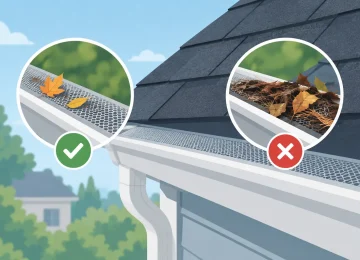
Gutter guards can reduce debris buildup and cut down on how often cleanings are needed. For many homes and buildings, they are a practical way to improve drainage reliability. They are especially helpful where nearby trees drop leaves, seed pods, or small debris throughout the year.
Still, guards are not a cure-all. If gutters are installed with the wrong pitch, if downspouts are undersized, or if the gutter itself is too small for the roof area, guards will not fix those design problems. They can help keep the path clearer, but water still needs enough capacity and a proper route to drain away.
That is why a good recommendation should start with an inspection, not a one-size-fits-all add-on. The goal is not just to keep debris out. The goal is to make sure rainwater is captured and moved away from the structure efficiently.
When repair makes sense and when replacement is smarter
Repairs make sense when the system is fundamentally in good condition and the problem is specific. A loose section, a failed hanger, a disconnected downspout, or a localized pitch issue can often be corrected without replacing everything. If the gutter material is still sound and the design is appropriate for the building, repair is usually the practical first step.
Replacement becomes the better investment when problems are widespread or recurring. If the gutters are aging out, rusting, separating at multiple seams, or repeatedly overflowing because they were never sized correctly, repairs can turn into a cycle of temporary fixes. At that point, replacement is often more cost-effective and more protective of the property.
For some properties, upgrading the gutter size or changing the downspout layout is what finally solves the problem. Bigger is not always necessary, but neither is forcing an undersized system to keep failing every storm season.
Why overflow should not be ignored
It is easy to put off gutter work because the damage is often gradual at first. But water has a way of turning small issues into expensive ones. What starts as occasional overflow can lead to fascia rot, soffit damage, basement moisture, foundation settlement concerns, mold-prone damp areas, and landscape washout.
The timing matters too. If you only address the problem after a major storm, contractors are often busier, and the damage may already be spreading. Preventive service is usually simpler and less disruptive than emergency work after water has been getting into places it should not.
For property managers and commercial owners, there is also the liability side. Overflow near doors, walkways, and tenant areas can create slip hazards and complaints. Keeping drainage under control is part of protecting both the building and the people using it.
What a professional evaluation should look at
A proper gutter assessment should go beyond whether debris is visible. It should consider the roof area feeding each run, the number and placement of downspouts, the gutter size, the pitch, the condition of fasteners and fascia attachment points, and whether the discharge is moving water far enough away from the structure.
It should also account for the property itself. Tree coverage, roof height, valleys that dump concentrated water, and ground grading all affect performance. Two homes on the same block may need different solutions because the rooflines and runoff patterns are different.
That is why specialized gutter contractors often spot problems that general exterior crews miss. Water management is not just about attaching metal along the roof edge. It is about designing a system that performs in real weather on that specific building.
For homeowners and property owners in New Jersey and Staten Island, local weather patterns make that practical approach even more important. A system has to be ready for seasonal debris, summer downpours, and the wear that comes with changing conditions throughout the year.
If your gutters are overflowing in heavy rain, the safest assumption is that the system is asking for attention. Sometimes the answer is a thorough cleaning. Sometimes it is a repair. Sometimes it is a better-designed replacement. The important part is not waiting for the next storm to tell you the same thing again. If you want clear answers and dependable workmanship, Cavallari Gutters can evaluate the system and point you toward the fix that makes sense for your property.
A gutter system does not need to be flashy to do its job well. It just needs to move water where it belongs, every time the weather tests it.

Leave a Reply