
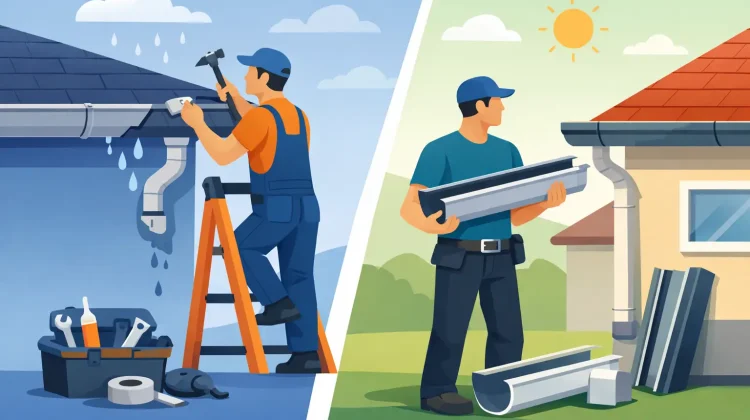
A gutter system usually starts asking for attention after a storm, not on a convenient day. Maybe you see water spilling over the front entry, a section pulling away from the fascia, or a puddle forming too close to the foundation. When that happens, the question is usually the same: is this a repair job, or is it time for a full replacement?
That is the real issue behind gutter repair vs replacement. The right answer depends on the age of the system, the extent of the damage, how well the gutters were installed in the first place, and whether the current setup is still doing its job during heavy rain. A small failure can often be corrected. A system with widespread problems usually costs more to keep patching than to replace properly.
How to think about gutter repair vs replacement
The easiest way to approach this decision is to look at function first, not just appearance. Gutters are there to move water away from the roofline, siding, foundation, walkways, and landscaping. If they are not managing runoff effectively, the issue is bigger than a cosmetic defect.
Repair makes sense when the problem is isolated and the rest of the system is still structurally sound. Replacement makes more sense when the system has multiple weak points, recurring leaks, poor pitch, or visible aging throughout. In other words, one bad section is different from a failing system.
This is why a professional inspection matters. Two homes can show the same symptom, like overflowing gutters, and need completely different solutions. One may just need a minor slope adjustment and resealing. The other may have undersized gutters, separated seams, and fascia damage hiding behind the metal.
When gutter repair is the smarter option
Repairs are often the better value when the gutters are relatively newer and the damage has a clear, limited cause. A bracket may have loosened. A seam may have opened. One section may have been bent by a ladder or storm debris. These are fixable issues if the surrounding material is still in good condition.
Small leaks are a common example. If the leak is coming from a seam, end cap, or fastener point, resealing or replacing a localized section can restore performance. The same goes for gutters that have started to sag in one area because of loose hangers. If the metal itself is not badly corroded or split, the section can often be resecured and pitched correctly.
Downspout issues also tend to be repair-friendly. A disconnected elbow, crushed outlet, or poorly directed downspout can cause a lot of water trouble without requiring a whole new gutter system. Correcting water flow at the downspout can make a major difference quickly.
Repairs also make sense when the existing system matches the property well in size, style, and capacity. If the gutters are otherwise doing their job and the issue is isolated, replacement may be more than you need.
Signs replacement is the better investment
There is a point where repairing gutters becomes a short-term patch on a long-term problem. If you are seeing issues in several places at once, replacement often saves money over time and gives you a more reliable result.
Frequent leaks are one of the clearest warning signs. If one section gets fixed and another starts leaking a few months later, the system may be wearing out as a whole. The same is true when gutters are pulling away from the house in multiple areas. That can point to failing fasteners, rotted fascia, poor installation, or too much stress from repeated clogging and overflow.
Rust, cracking, and seam separation are also signs that the material has reached the end of its useful life. Once corrosion spreads, repairs become less predictable. You may stop one leak, but the metal around it may already be weakening.
Another replacement trigger is poor design. Some homes and commercial buildings have gutters that were undersized from the start, installed with the wrong pitch, or laid out with too few downspouts. In those cases, the system may have struggled for years, especially during New Jersey and Staten Island storms. Replacing the system with the right size and configuration can solve problems that repairs never fully address.
The hidden costs of waiting too long
Property owners often put off gutter replacement because they want to avoid a larger upfront cost. That is understandable. But delayed action can lead to damage that is far more expensive than the gutter work itself.
Overflowing or leaking gutters can send water behind siding, into soffits, around windows, and down toward the foundation. Over time, that can contribute to wood rot, staining, erosion, basement moisture, and damage to masonry or pavement below. On commercial properties, poor drainage can also create maintenance issues around entries, facades, and pedestrian areas.
This is where gutter decisions stop being about metal channels and start being about protecting the structure. If the system is no longer controlling water reliably, continuing to patch it may increase the total cost of ownership.
Age matters, but condition matters more
Many people want a simple age rule, but gutters do not fail on the same schedule. Material type, installation quality, tree coverage, storm exposure, and maintenance history all affect lifespan.
A well-installed system that has been kept clean may still have good years left in it. A newer system that was poorly pitched or loosely fastened may need major work much sooner. That is why age should be treated as one factor, not the deciding factor.
What matters more is the overall condition. Are the gutters secure? Are they draining properly? Do they still have the strength to handle heavy rainfall without separating, bowing, or leaking? If the answer is no in more than one area, replacement deserves serious consideration.
Why sectional gutters often create repeat problems
Older sectional gutters can sometimes become maintenance-heavy because they have more joints and seams. Every seam is a potential weak point. As sealant ages and materials shift, leaks become more common.
That is one reason many property owners move toward seamless gutter systems when replacement is needed. Fewer joints usually mean fewer leak opportunities and a cleaner fit along the roofline. For homes and businesses that have dealt with repeated seam issues, this can be a practical upgrade rather than just a cosmetic one.
If a property has been repaired multiple times at the seams, replacement with a better-configured system may be the more dependable path.
A repair can be right even if replacement is possible
Not every worn gutter system needs to be replaced immediately. Sometimes a targeted repair is the right decision because it solves the current problem safely and buys time for planning a larger project.
That can be true for owners preparing for a roof replacement, managing a property budget, or addressing one urgent drainage issue before peak storm season. The key is honesty about what the repair will and will not accomplish. A good contractor should be clear if the repair is expected to last or if it is simply a temporary measure.
That kind of communication matters. Property owners deserve to know whether they are paying for a true fix or a short extension of a system that is already near the end.
What a professional evaluation should include
A proper gutter assessment should go beyond a quick glance from the ground. The contractor should check for visible leaks, separated joints, sagging runs, loose hangers, standing water, outlet performance, and signs of fascia or soffit damage. They should also look at whether the gutter size and downspout layout are appropriate for the roof area and runoff volume.
This is especially important on larger homes, mixed-use buildings, and commercial properties where drainage demands can be more complex. What looks like a simple overflow problem may actually be a capacity issue.
For local property owners, working with a gutter specialist rather than a general exterior company can make a difference here. Cavallari Gutters focuses on gutter systems as a core trade, which is exactly what this type of decision calls for – practical diagnosis, not guesswork.
The right choice is the one that restores confidence
The best answer in the gutter repair vs replacement decision is the one that gives you a dependable system when the next heavy rain hits. If a focused repair will do that, there is no reason to replace more than necessary. If the system has become a cycle of leaks, overflow, and callbacks, replacement is usually the more responsible investment.
A good gutter system should not leave you wondering where the water is going every time the forecast turns. It should do its job quietly, protect the structure, and let you move on to everything else that matters on your property.
Leave a Reply